Eurocrim2025 - Conference report
Wim Huisman
VU University of Amsterdam
01-28-2026
The 25th edition of the annual conference of the European Society of Criminology (ESC) was special for several reasons. Not only because it was a festive anniversary that took place in the beautiful and historic city of Athens, but also because the conference was accompanied by unprecedented debate and controversy. It felt as if two events were happening simultaneously. On the one hand, there was the usual conference, with a rich program full of fascinating plenaries and panels on numerous criminological topics, award ceremonies, and social gatherings for networking. On the other hand, there was an ongoing debate, both within and outside the official conference program, about the war in Gaza and the Society’s position regarding the atrocities taking place. Below, I will first reflect on this extraordinary aspect of the conference. After that, I will briefly report on the traditional elements of the event.
Serious geopolitical and societal developments have previously cast a shadow over ESC conferences, such as the COVID-19 pandemic and Russia’s invasion of Ukraine. During COVID, for 2020 and 2021, the conferences were fully held online. For Ukraine, the ESC board produced a statement (to be found here) and a series of activities to support colleagues affected by the war in Ukraine, such as scholarships. But never before had there been an issue that so deeply engaged many participants as the war in Gaza and the horrors that triggered this war and occurred within it. Discussions about the conflict and its relation to the ESC began weeks before the conference. A group of members united under the name Criminologists4Palestine submitted a motion to the ESC board, requesting that it be put to a vote during the General Assembly at the conference. According to the board, parts of the motion were unconstitutional and therefore could not be presented for a vote. However, the board decided to dedicate an agenda item to the motion and its response. The text of the motion, the board’s reaction, and a letter from the Israeli Society of Criminology were sent to members well before the conference, sparking discussions in various forums. Since this brief report cannot provide a substantive account of the positions and debates, I refer readers to the websites of the collective and the ESC.
Within the society, the discussion – in my view – remained substantive and respectful, while heated. That changed when the internal debate was picked up by outsiders via social media. Board members were personally accused of complicity in genocide and received threats. Pantheon University withdrew from hosting the event with a short statement days before the start of the conference and also the city of Athens withdrew its support. Amid the turmoil, misinformation also spread – for example, claims that the conference had been moved last-minute to the campus of the American College of Greece, which allegedly has ties to Israel. During the opening ceremony, the chair of the organizing committee, Effi Lampropoulou – whose university had withdrawn – assured attendees that the choice of campus had been made years earlier for logistical reasons. And while the motion contains several elaborated positions and targets Israeli academic institutions as legal entities only, discussions boiled down to the question whether (the motion called for) to boycott individual Israeli scholars. For many, the presence of scholars from universities in occupied territories in Palestine in the conference program functioned as a case in point.
During the traditional opening ceremony and reception, demonstrators protested outside the campus, with a heavy presence of riot police commissioned by the Greek authorities. The climax came during the General Assembly. Usually, this meeting is a rather dull event with low attendance, as many members use this time slot for an extended lunch meeting. However, both Criminologists4Palestine and the ESC board had called on members to join the assembly, and the allocated aula was packed. After discussing and deliberating about other matters in the order of business, two representatives of Criminologists4Palestine were given five minutes to present the motion. It then followed a lineup of speakers delivering emotional statements, including Israeli scholars working with Palestinian students and three former ESC Presidents. Due to the intensity and eagerness to speak, ESC President chairing the General Assembly, Michele Burman, struggled to keep the debate orderly. Speakers used their few minutes to emphasise different aspects of the complex issue with great emotion and concern. Despite the evident tension, my perspective is that the discussion remained respectful: no accusations or threats to fellow scholars were made.
The extent to which participants were involved in these two sides of the conference varied. Some tried to escape from the controversy, while others were completely submerged by it. Many colleagues felt compelled to determine their own position on the matter. This proved to be a difficult task, as the discussion touched on so many issues: from the nature of the conflict and the characterisation of atrocities, to the positions of the motion’s proponents and of the ESC Board, and the presence of colleagues from universities in Israel and the occupied Palestinian territories. Members struggled with what is “the right thing to do” – whether to travel to Athens, attend the program, act as chair, deliver the scheduled presentation, and, if so, whether to make a personal statement. This resulted in noticeable gaps in the program, although reasons for absence were not always clear.
My impression was that especially early-career scholars decided to make personal statements about the conflict at the start or at the end of their presentations. The emotion and nervousness that often accompanied these statements were understandable, as they likely wondered what consequences this might have for their relationships with supervisors and the trajectory of their academic careers. Also, during plenary sessions, some of the keynote speakers made reference to the debate and stated their position. For instance, in his acceptance speech upon receiving the 2025 ESC European Criminology Award, Ernesto Savona did so by addressing the challenges facing the field in times of strong geopolitical instability.
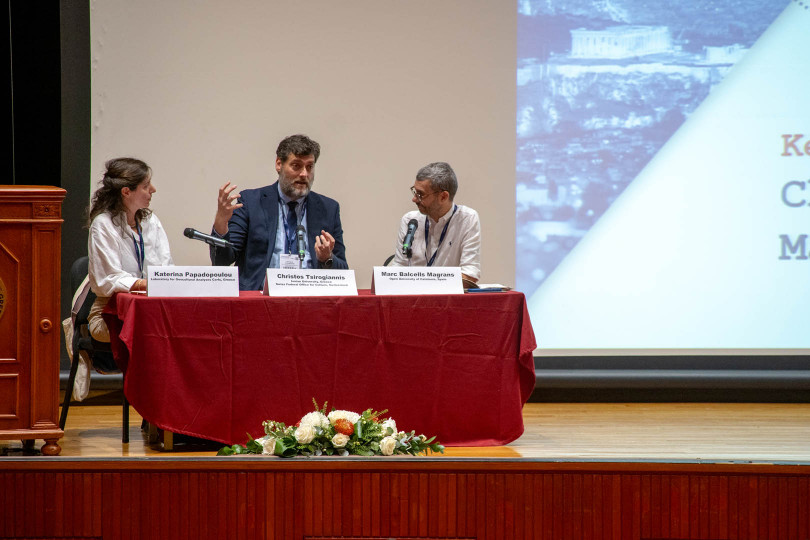
I will now use this bridge to share some impressions of the ‘regular’ program. As always, the conference location and the overarching theme of the conference – ‘Logos of crime and punishment’ – were reflected in the plenary keynotes. As a city so rich in cultural heritage, Athens is of course the right place for a plenary session on illicit trade in antiquities. While being a niche in Criminology, the speakers were able to show how law enforcement practitioners and academics (in this case, with a background in Archaeology) work closely together for instance, to develop AI tools to screen museum collections for stolen art. They also showed how, with notable exceptions, top private collectors as well as leading museums prove to be persistent offenders. At the stimulating plenary on terrorism and border control, Lucia Zedner and Maartje van der Woude warned Criminology of complicity to the harms of border policing when, for instance, it adopts populist language that is commonly used to reframe migration policy as fighting terrorism. The mere fact that we study this from a criminological standpoint implies a criminal justice frame and the speakers concluded that approaches generated by Critical Criminology and by Zemiology are needed to uncover the undetected harms of border control.
The Saturday plenary focused on the use of Artificial Intelligence (AI) in the criminal justice system. While its current use does not yet meet the demand and expectations from the field, both speakers made clear that regulation is lagging, notwithstanding the recent EU AI Act. The development of AI poses fundamental regulatory challenges, as algorithmic transparency is the basis of accountability. And while the availability to test outcomes is crucial, models of reasoning of generative AI are very opaque, which even developers do not fully understand. And while it seems that Big Tech welcomes the use of agentic AI, that is, systems that have autonomy to act on our behalf, experts seem concerned about the increased tendency of AI to power seeking and deceit. The talks showed how the loss of human control poses regulatory challenges, bringing AI-agency into the scope of Criminology.
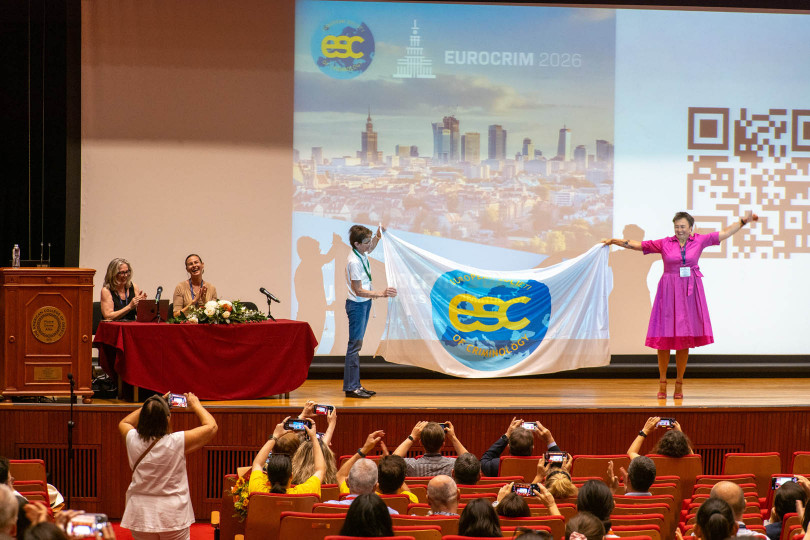
In this short report, it is impossible to do justice to the enormous variety of topics that were covered by the over 480 panel sessions that attendees could choose from. What is clear, however, is that many ESC Working Groups do excellent work in arranging these panels and inviting members to submit their abstracts. European Criminology is still growing and expanding, and I am sure this will be illustrated by the 26th annual conference in Warsaw, which will take place from 9 to 12 September 2026.
In the meantime, the discussion about the society’s position and actions regarding atrocities in Gaza continues. At the closing ceremony of the conference, President Burman confirmed that the board will return to the membership with a set of concrete questions that will be decided upon through a democratic vote. Recently, the ESC-board reconfirmed its commitment and also announced extra steps. Criminologist4Palestine continues to critically monitor and comment on these actions. In closing the conference, the host of the 2026 conference, Dagmara Wozniakowska, expressed the hope that all disputes would be settled before the Warsaw conference, wishing all a happy 2026 conference. To the extent that is appropriate for a discipline that studies crime, including atrocities, of course.