Special feature from the 25th anniversary of the ESC: Riding with Kings and Queens: a Squire’s Chronicle of an Unlikely Journey
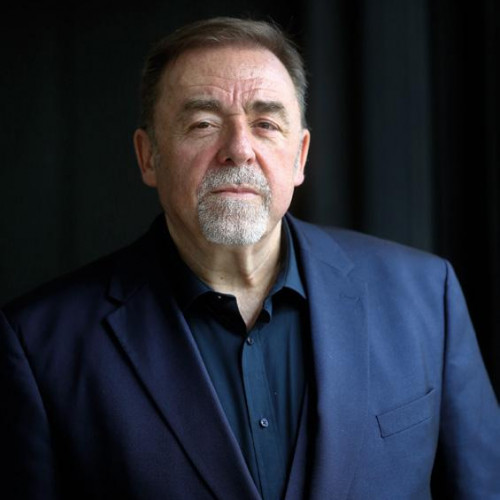
Marcelo Aebi
Executive Secretary of the ESC
01-28-2026
Author’s Note
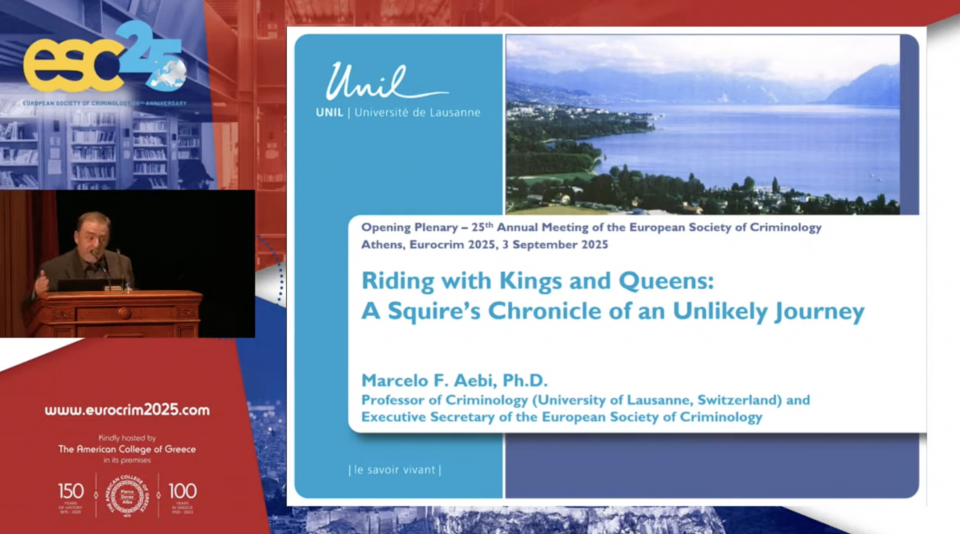
The following text represents my address at the opening plenary of the European Society of Criminology’s 25th Annual Conference, held in Athens on 3 September 2025. While edited for clarity, I have sought to maintain the conversational tone of the original oral delivery. The plenary is available on the ESC’s YouTube Channel.
All quotes from ESC Presidents are drawn from their presidential messages published in the ESC Newsletter Criminology in Europe over the past twenty-five years.
Introduction: A Remark You Made
“The man who said ‘I’d rather be lucky than good’ saw deeply into life”, says Woody Allen at the beginning of Match Point. I was lucky enough to be in the right place at the right time, and like a hobbit drawn into an unexpected adventure, I found myself embarked on a journey I could never have foreseen.
The journey I want to talk to you about starts in 1999, when I was a PhD student under Martin Killias’s supervision at the University of Lausanne. One afternoon, Martin invited the research assistants for coffee. This did not happen often. With time, I realized it was the strategy of an experienced researcher who liked to test ideas aloud and check their effect.
“I’ve been thinking,” he said. “It’s rather stupid to have two hundred European criminologists crossing the Atlantic each year to attend the American Society of Criminology’s annual conference. Perhaps it’s time to create a European Society of Criminology”.
Soon after, he involved Josine Junger-Tas. I was fortunate enough to have both Martin and Josine as professors in my postgraduate studies, and later again during my PhD – one supervising my thesis, the other sitting on my jury.
I was lucky a third time a few months later, at the 1999 ASC conference in Toronto – the last one in Canada before September 11 changed everything. There I was, at a quiet dinner for six – including Josine, Marianne Junger, and Michael Gottfredson – when Martin presented the project with a concrete plan of action.
That evening, I could never have imagined that more than twenty-five years later I would stand here as Executive Secretary of the European Society of Criminology. Like a medieval squire chronicling the deeds of kings and queens, I have had the privilege – since 2004 – of serving alongside twenty Presidents: each a sovereign of ideas, each a guardian of the values that have shaped our society.
Today, as we celebrate our silver anniversary, I want to share what I have learned from this unlikely journey – not through my own words, but through theirs. Through the voices of the Presidents who have led us. Their messages, published in the ESC Newsletter over a quarter century, reveal not only the history of an academic society, but the soul of European Criminology itself.
Before we begin, I must echo Jorge Luis Borges, who observed that in every anthology the first thing you notice are the absences. I therefore apologize to Ernesto Savona and Krzysztof Krajewski – whom you have just heard in this plenary – and to Vesna Nikolić and Klaus Boers. I could not include all twenty-five Presidents in this brief narrative; what follows is only a glimpse. But believe me: “I’ve seen things you people wouldn’t believe”.
The Foundations: Enlightenment Values
Our story begins with foundations laid in the Enlightenment itself. Our second President, Josine Junger-Tas, set the tone in 2002 with words that continue to guide us today: “May we develop a European Society of Criminology that reflects truly European values: those of the Enlightenment – emphasising reason, empiricism, and human rights – and those of social care and support for the losers in our society”.
These were not ceremonial platitudes. They were a declaration of principles that would define who we are and who we would become. Reason over rhetoric. Evidence over ideology. Human rights over state power. And always solidarity with society’s most vulnerable.
Open to All
From the beginning, openness was not just a policy but a philosophy. Our third President, Paul Wiles, articulated this democratic vision: “The dream that led to the ESC was that we should have a European-wide society to pursue scientific research in Criminology – but that this should be open to all (not only by invitation) and that its development should be in the hands of a board elected by its members”.
Think about what this meant in 2002. Many academic societies were – and still are – exclusive clubs, accessible only by invitation or recommendation. We chose a different path. We chose radical openness.
Michael Tonry, our 14th President, reinforced this commitment in 2013: “From the outset, the successive ESC boards have tried to be inclusive. One way was by moving the meetings around Europe. As long as applications kept arriving from ‘new’ countries, no country repeated. Another way was by trying to attract presidential candidates from ‘new’ countries”.
This wasn’t charity or tokenism. It was recognition that Criminology needs all voices, all perspectives, all experiences to understand the complex realities of crime and justice.
On Language
But openness brings challenges. How do we communicate across dozens of languages? Our fifth President, Sonja Snacken, addressed this with characteristic wisdom: “We need a common language to communicate and to compare our experiences and, in practice, that language is now English. But we should not take it for granted”.
She continued with an observation that resonates deeply: “English is their second or third language for many criminologists who attend our annual meetings. I sometimes feel a new ‘European’ or ‘international’ English is emerging which all Europeans seem to understand. It may require some flexibility from native English speakers, and more emphasis on clarity of expression than on eloquence. Language should be communication, whether it is our first or our third language”.
This isn’t just about linguistics. It’s about humility, about recognizing that communication requires effort from all sides, about valuing clarity over cleverness.
Building the Community
Building a truly European community has been another constant challenge and, I would say, the greatest achievement of the ESC. Kauko Aromaa, our seventh President, captured both the difficulty and the promise: “Criminology is a hugely diverse field. Many criminologists, in Europe and elsewhere, do not consider themselves criminologists at all. This is due to the wide-ranging nature of the discipline: crime and crime control can be approached from many different perspectives”.
He identified a persistent challenge: “Eastern European colleagues often find it difficult to identify partners from Western European countries to participate in joint research projects”. Yet he saw hope: “ESC conferences are potentially an important forum to promote greater mingling of East and West, North and South”.
Miklós Lévay, our 11th President, made this challenge personal and urgent in 2010: “One of the main objectives of the ESC is to be a pan-European organisation for our discipline, providing and ensuring a forum for criminologists from all regions of the continent. My aim is to draw attention to the fact once again and to declare that one main goal of my presidency will be to contribute to the accelerated participation of criminologists from Central and Eastern Europe”.
Gorazd Meško, our 18th President, continued this mission, emphasizing the opportunities for developing Comparative Criminology in South-Eastern Europe. He noted that ESC conferences bring “a vast number of ideas for comparative criminological research and the development of different perspectives on crime and criminality”, and he highlighted the importance of regional research projects that could contribute to a broader European understanding. The Balkan Criminology working group became one concrete expression of this commitment to include voices from all corners of Europe.
A few months later, our next President, Tom Vander Beken, underscored that visiting Sarajevo in 2018 was not merely symbolic but a genuine commitment to discovery: “I have found the Sarajevo conference particularly interesting because it brought us to a city and area in Europe that only some of us know or visit as criminologists”.
And from the South, our ninth President, Elena Larrauri, brought another crucial perspective: “I often find it frustrating that data and case studies of penal policy almost never come from Southern European countries. It is frustrating not to be able to find your country when lists and typologies are done, because this seems to exclude us from all these interesting discussions”. But she ended with optimism: “I hope the questions posed by the South can enrich analyses being produced elsewhere in Europe. This is among others the task of the ESC, to facilitate this sort of comparative work. Long life to ESC”.
And I believe that, if you go through the successive volumes of the European Journal of Criminology, you will see that this task has somehow been achieved.
Growth and Independence
As we grew, we also defined our distinctive identity. Michael Tonry’s analysis of 2014 remains definitive. He began with history: “There was definitely a European Criminology in the nineteenth and early twentieth centuries. The adjective ‘European’ was redundant”. Then he identified what makes us distinctive today: “First, European Criminology is especially attuned to pursuit of social justice, exemplified by the Scandinavian mantra that the best crime policy is a good social policy. Second, European Criminology is more humane than that in some other places. Third, European Criminology is internationalist. Fourth, Criminology in Europe much more than in the English-speaking countries is compatible with Edwin Sutherland’s description of a discipline concerned with the making, the breaking, and the enforcement of criminal laws. Fifth, European Criminology retains a strong link with the humanities rather than only or principally with quantitative social, physical, and biological sciences”.
These aren’t just academic distinctions. They represent fundamental choices about what Criminology should be and do.
The reflection on French Criminology of our tenth President, Sophie Body-Gendrot, revealed the tensions within our growth: “The contested status of ‘Criminology’ in France leads to schizoid positions: those who claim to be criminologists reject the study of issues that are regarded elsewhere as a genuine component of Criminology, whereas those who focus on such issues refuse to be called criminologists in France but do so elsewhere (as at ESC meetings, for instance)”.
This paradox – being criminologists abroad but not at home – speaks to the complex politics of our discipline and the importance of the ESC as a space where we can be who we truly are.
Henrik Tham, our 12th President, brought us back to practical matters with key advice: “It is most important when writing a paper for an ESC conference to think in terms of ‘the other’, that is, the participating criminologists from other countries. Some presenters seem to take for granted that national conditions are well known in other European countries. They are usually not”.
His challenge remains vital: “Ask yourself: ‘In what way can my paper be of interest and helpful to someone from Spain, Denmark or Lithuania?’ This will improve the scientific quality”.
Dialogue
The challenge of genuine dialogue has been constant. Gerben Bruinsma, our 15th President, diagnosed a problem in 2014: “One of the underlying motives of the founding mothers and fathers who established the ESC years ago – which was also set as a formal goal – was to bring together European criminologists annually and to stimulate among them mutual discussions and an exchange of ideas. Although the society succeeded in bringing together European scholars more than was expected in advance, the mutual discussion between the members of the society did not completely live up to its promise. I imagine that the existence of schools of thought has much to do with that and in a way has fragmented the society”.
His prescription was simple but profound: “To bring more closely together the members of the ESC, I would like to call upon the Porto participants to attend at least one of the sessions on topics and issues they are not familiar with. As an optimist, I still believe that we can learn from other schools how and why they formulate research questions, how they carry out empirical and theoretical studies and how they solve practical and methodological research problems within their schools”. So, I encourage you to take his advice for this conference that is starting tonight.
Facing Crises
Of course, throughout our history, we have faced crises. Crises that tested both our values and our relevance. The refugee crisis of 2015 prompted our 16th President, Frieder Dünkel, to declare: “Criminologists should raise their voices and contribute to a rational discourse about immigration, crime and the possibilities for a humanitarian solution. I really hope that not only in countries like Hungary and others in Eastern Europe, but also, for example, in the UK, criminologists will protest against politics of foreclosure”.
Frieder added: “We should furthermore address the causes of the refugee problem: the conflicts in the Middle East, poverty and food shortage in regions of ongoing civil war, such as in Libya. Therefore, war, conflicts, religious and political persecution and the role of state crime should be discussed”.
Then we arrive at our 17th President, Rossella Selmini, who brought a feminist perspective to the burqini controversies of those days: “The burqini cases – like the ‘anti-prostitution’ ordinances – do not raise issues only about legal rights and ethnicity. They are also on matters of gender in many different ways”. Her conclusion was both political and deeply human: “As a citizen and as a woman, I think we should be happy to see Muslim women bathing in the Mediterranean Sea, in whatever clothes they choose, rather than dying trying to cross it”.
This point becomes especially interesting when connected to what Henrik Tham said about contextualising our national experiences. From that perspective, another reason why I am fortunate is that I live in a country with direct democracy, which creates its own specific challenges. For example, regarding the prohibition of full-face coverings in public, including burqas and niqabs, several cantons held popular votes. The results varied: in some cases, voters rejected the prohibitions, while in others the bans entered into force with majority support. This raises a fundamentally different set of questions. It is easy to speak of penal populism and blame politicians, but when it is the public itself that votes, the challenges become far more complex. Criticising these decisions without adopting an elitist stance becomes very difficult. Similarly, prostitution is legal in Switzerland, which generates different policy challenges – for instance, we have less human trafficking, as Lorena Molnar and I showed in our research.
The pandemic brought new challenges and new insights. Lesley McAra saw it as a moment for fundamental reflection: “The transformations wrought by the global pandemic present us now with the opportunity (and, I would suggest, the imperative) to revisit Josine Junger-Tas’s founding ambition for the Society”.
Lesley was our twentieth President, and she engaged in a dialogue across time and space with Josine, our second President. Consequently, Lesley called us back to first principles: “I believe we need to re-engage with a number of normative questions: what are the conditions of a just social order; what promotes social solidarity; what are the structural conditions which support human flourishing; how can human rights discourse come to infuse and transform institutional cultural practices?”.
The war in Ukraine brought new urgency to our work. Catrien Bijleveld, our 22nd President, reminded us: “While Europe has been relatively peaceful since World War II, wars have been fought in Europe, however, and Ukraine is not the first time we have seen atrocity crimes committed on European soil. As criminologists we need to contribute to unravelling and understanding such ‘unimaginable’ violence committed around the world as we speak”.
And then Josep Maria Tamarit, our 24th President, expanded this concern: "European criminologists will continue to be very much concerned about the war in Ukraine... Since October 7th, new concerns have been added to the current ones due to the horrific war in Palestine. Research on war crimes and atrocity crimes is nowadays even more a matter of interest for criminologists".
Crises, whether humanitarian, political, or global in scale, have repeatedly tested our values as a community. Yet time and again, the ESC has responded not with rhetoric but with reflection, reason, and a renewed commitment to understanding.
And yet, history is never only a sequence of crises. Beneath the turbulence, another story was unfolding – a quieter story, but one no less important: the consolidation and expansion of Criminology across Europe.
Building and Expanding Criminology Across Europe
Parallel to these crises – and sometimes despite them – European Criminology has continued to grow in ways that would have astonished our founding fathers and mothers. Our 21st President, Aleksandras Dobryninas, writing during the pandemic, shared: “Despite all the troubles and obstacles, our Society and its members’ academic activity have never stopped generating new projects, publications, educational programs, and expertise. Recently, at my alma mater, Vilnius University, we had a remarkable event – 48 graduates received their Bachelor diplomas in Criminology, the first Bachelor program in the field nationwide”.
This is, I believe, proof of the success of the European Society in bringing Criminology to Eastern Europe. Similar programs have emerged in Hungary and elsewhere. When you compare this to the early years – the first presidential messages I quoted – the transformation is remarkable. The dream of our regretted friend Kauko Aromaa and the ambition of Miklós Lévay for greater Central and Eastern European participation are, at some level, becoming reality. Last year, we were in Bucharest for a conference under the slogan “Criminology goes East”, and next year we return to Central Europe, to Poland, continuing this trajectory.
What I Did Not Find
Now let me tell you something equally important: What I did not find in twenty-five years of presidential messages.
I did not find paternalism – no President ever wrote “we know better than you”.
I did not find claims of false consciousness – no one said “you’re brainwashed if you disagree”.
I did not find virtue signalling or a Manichean worldview – no declarations that “we embody justice; others are evil”.
I did not find tyranny of virtue or puritanism demanding “no compromise, only purity”.
I did not find a teleology of progress claiming “history is inevitably on our side”.
I did not find cancel culture or moral absolutism declaring “dissent is immoral”.
I did not find the totalitarian temptation that “everything is political, no neutrality exists”.
I did not find soft authoritarianism restricting freedom “for your own good”.
This absence is not accidental. It reflects the deepest values of our society. We are scholars, not prophets. We seek understanding, not converts. We value debate, not dogma.
The ESC as Enabler
Our current President, Michele Burman, captures what we have become: “The ESC is also an enabler. Through its activities, events and networks it enables connections to be forged, new criminological questions to be posed, and the continuing pursuit of more perennial ones”.
Michele continues: “Moreover, through its provision of an open and inclusive environment, the ESC offers an opportunity to support the objectives listed in its constitution whilst fostering an open and inclusive environment nurturing ideas and links across borders”.
What I Learned from My Ride
After twenty-five years riding alongside these kings and queens of Criminology, what have I learned about what the ESC truly is?
From Martin Killias to Michele Burman, from Enlightenment ideals to present crises, the chorus is clear:
We are not a faction. We are not a platform for demands.
We are something rarer: a society built on reason, on dialogue, on human rights, and on respect.
We are an open forum. We are a home for debate. We are a society for all.
This is not weakness or indecision. In an age of polarisation, maintaining a space for genuine dialogue is an act of courage. In a time of tribal certainties, insisting on evidence and reason is revolutionary. In a world of closing borders, remaining open to all is radical.
Conclusion: The Next Chapter
As we celebrate twenty-five years, we face new challenges. Hybrid societies, artificial intelligence, climate change, and democratic institutions are facing threats we haven’t seen since our founding. Wars rage on European soil and beyond.
Yet I am not pessimistic. Why? Because I have ridden with kings and queens who faced their own crises with wisdom, courage, and humanity. Because I have witnessed a society that grows stronger through adversity. Because I have seen young criminologists – in Porto, in Bucharest, in Helsinki, in Athens – eager to carry forward our mission.
The European Society of Criminology at twenty-five is not perfect. We still struggle to include all voices equally. We still face the tension between scientific independence and political relevance. We still grapple with how to make our research matter in a world that often seems to prefer simple answers to complex truths.
But we continue. We continue because we believe in what Josine Junger-Tas called “reason, empiricism, and human rights”. We continue because we know that understanding crime and justice requires all perspectives, all methods, all voices. We continue because, as this unlikely squire has learned from his journey with kings and queens, the work of building a truly open, truly inclusive, truly scientific community is never finished. It must be renewed by each generation, defended against each threat, and expanded to include each new voice.
So let us raise our voices to the next twenty-five years of the European Society of Criminology – may they be as rich in wisdom, as strong in values, and as open in spirit as the first.