Special feature from the 25th anniversary of the ESC: The Futures of European Criminology?

Anna Di Ronco
University of Essex; University of Bologna
01-28-2026
What does the future of European Criminology look like in your field over the next 25 years? What will its main challenges and potential achievements be? How can the European Society of Criminology (ESC) support these developments?
We posed these questions to a small group of mid-career European criminologists during a prearranged roundtable at the last annual ESC conference in Athens, Eurocrim 2025. But who were these scholars, and why did we choose them to answer these questions?
Let us proceed in order.
This year, the Society celebrated its 25th anniversary—a milestone for our intellectual community. To mark this achievement, the ESC Board invited the Society’s Working Groups to organise a series of featured panels reflecting on the development of their criminological scholarship over time. In addition, the Society’s Board organised its own panels and roundtables, ranging from past Presidents reflecting on the highlights of their terms, to younger generations envisioning the future of European Criminology.
It is the latter roundtable that I volunteered to organise, with the help of Csaba Győry, my fellow Board member. In this piece for the newsletter, I would like to offer a brief account of that effort.
Who did we choose for this challenging task?
Selecting participants for this roundtable was no easy task. European Criminology is rich with excellent research, making it difficult to select colleagues for this task. We ultimately based our choices on several criteria: gender and geographical diversity (covering multiple European countries), diversity in topics of interest and methodological expertise, and prior engagement with the ESC—either through Board service or recognition via ESC awards.
The scholars we invited are: Jakub Drápal (Charles University), Csaba Győry (ELTE University), Beth Hardie (University of Cambridge, who unfortunately couldn’t attend the conference), Anita Lavorgna (University of Bologna), Kjersti Lohne (University of Oslo), and Olga Petintseva (Vrije Universiteit Brussel).
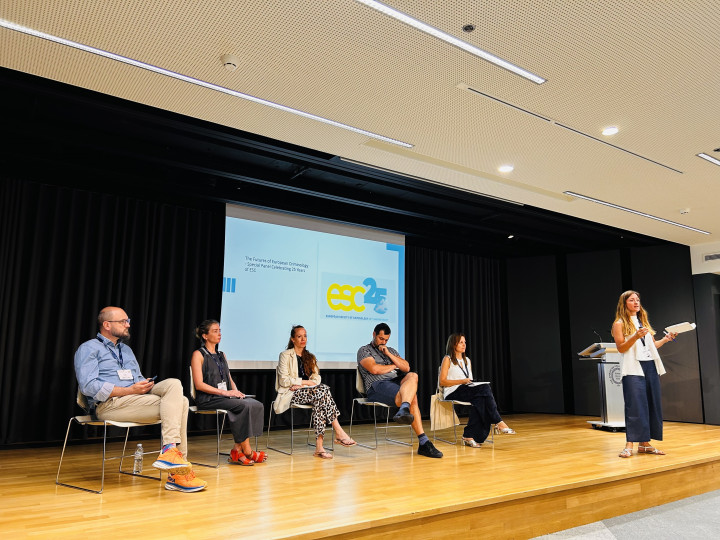
They were asked to envision the next 25 years of European criminology, and their perspectives were as diverse as one might expect. Yet they shared a common trait: they responded to our questions with more questions and, at times, with suggestions. The remainder of this piece summarises some of these inquiries and recommendations.
Building on her interdisciplinary research on harmful online behaviours, Lavorgna identified several key challenges for a Criminology that aspires to—and is increasingly expected to be—interdisciplinary, particularly when examining the intersections between crime, deviance, control, and digital technologies. Perhaps the most important challenge Lavorgna highlighted can be captured in the following questions: will a growing emphasis on the infrastructures of new technologies—domains largely within the expertise of computational scientists, engineers, and other technical disciplines—render Criminology redundant or erode its distinctive contribution in this area? And, relatedly: how can Criminology retain its relevance and demonstrate the uniqueness of its contribution?
Drápal highlighted the need for our discipline to enhance its methodological sophistication, especially as an increasing amount of digitalised data—such as sentencing information—is becoming available across European countries and will continue to do so in the future. This presents an unprecedented opportunity for criminologists to analyse aspects of judicial decision-making, including courts’ discretion in sentencing, in ways that were previously impossible. However, without a corresponding advancement in methodological rigour, quantitative research on sentencing in Criminology risks being outpaced by areas such as Economics, where scholars already possess far greater technical expertise. The question remains: will criminologists rise to the challenge, or will this research area be dominated by other disciplines?
Győry drew our attention to the healthy state of research on corporate crime, a field that has traditionally maintained a critical edge and has seen substantial theoretical and empirical advancements. A major challenge in this area, however—contrary to Drápal’s observations—is the persistent lack of access to data owned and retained by private companies, often the very entities that commit crimes and generate interlocking harms. At the same time, and as Drápal also noted, the available data is becoming increasingly sophisticated, which will require Criminology to scale up its methodological competencies and build alliances with other fields and disciplines, including data science.
Speaking from the perspective of global criminology and international criminal justice, Lohne addressed the current crumbling state of the global order established by the international community since the Second World War. With the International Criminal Court under attack and many crimes against humanity left unpunished—or even condoned or treated more leniently, particularly when committed by Western nations or their close allies—questions arise about the future of international criminal justice: will it still exist in a few years, and if so, what form will it take? More broadly, are we moving toward a new and different global order—with the possibility that it may become an illiberal global disorder—and, if so, how should we confront it? These are difficult questions, but Lohne suggested that one useful step for Criminology would be to strengthen both intra- and inter-disciplinary engagement, while also drawing on the existing literature on illiberal regimes.
Finally, Petintseva emphasised that in today’s turbulent times, rigorous empirical work in Criminology can no longer avoid engaging with the normative questions that arise once we acknowledge the inherently political nature of studying crime and crime control. In other words, she noted, whether we like it or not, all our work is political—and criminological research can no longer deny this fact nor take refuge in a supposed ‘objectivity’ of data collection and analysis. This also implies taking political stances, when and if needed, to call out illegalities and atrocities as they happen.
All in all, the invited speakers highlighted the importance of the ESC in providing an open forum for academic debate, considering it vital to the development of our field. Whether fostering methodological innovation, addressing the challenges of interdisciplinary work, engaging with knowledge produced in other disciplines, or debating the nature of our work and the responsibility of our profession, they viewed the Society’s conferences as a valuable space for exchange, openness and mutual learning.