Presidential address: Criminological Authority and the Future of the ESC
Anna-Maria Getoš-Kalac
University of Zagreb
09-04-2026
Dear colleagues,
I would like to share some thoughts on what marked this year for our Society, what it taught me about criminological authority, and what that may mean for the future of the ESC. These questions converge on a simple one: what kind of scholarly society do we want the ESC to be?
I begin with the compromise reached after the first genuine stress-test our community has faced in its 25-year trajectory. Members had the opportunity to express fundamentally opposed views on how the ESC should engage with the armed conflict in Gaza. Dissenting voices may not always have felt welcome, been sought, or received prompt responses. Nevertheless, the views and inputs were factored in. In a polarised debate, the realistic outcome was a compromise: a membership vote on ‘votable’ questions distilled from the General Assembly’s discussion and tested against basic academic and fundamental-rights principles. The aim was to address core concerns without directly or indirectly undermining equal treatment or anyone’s right to maintain their “criminological home (away from home)”[1].
Unsurprisingly, that compromise fully satisfied neither side. But that is the nature of a compromise aimed at keeping a community together and in dialogue rather than dividing it beyond repair. Some objected to the vote, the questions posed or the solutions offered; others contested its constitutional mandate, democratic safeguards or representativeness. These concerns are valid, but I will not adjudicate them here. What matters is what the experience taught me - and perhaps us - about the scholarly society we want the ESC to be.
Throughout the year, I devoted much professional time and personal effort to listening to, engaging with and understanding opposing positions and different perspectives. Before this controversy, I had no affiliation or prior connection with either the colleagues raising the issue or the colleagues most affected by it, and neither group formed part of my professional or personal networks. My professional engagement was neither a campaigning exercise - it came after the vote was concluded - nor an institutional mission on behalf of the Executive Board or the ESC. I approached these encounters as a fellow criminologist and equal colleague, with genuine scholarly care: to grasp the concerns, arguments and experiences on all sides and, where possible, to identify some minimal common ground - or at least to ensure that different perspectives were heard and taken seriously.
As a scholar heavily engaged in what I understand as science activism - using scientific knowledge and methods to improve institutions and practice - I strongly identify with the idea that our profession and discipline can entail a moral calling and a right to seek a better and safer world[2]. In that scholarly and professional spirit, I felt genuinely welcome and engaged at a conference hosted by the Ljubljana Law Faculty’s Institute of Criminology exploring “Criminological Perspectives on Palestine”. In the same spirit, I participated in the biannual conference of the Israeli Society of Criminology and the Drapkin Conference, hosted by the Institute of Criminology at the Hebrew University of Jerusalem. It brought into sharp focus the complexities of terrorism and armed conflict and their human consequences on the ground. The value of both encounters lay precisely in listening and engaging without requiring agreement as a precondition.
What I learned through these encounters profoundly deepened and enriched - and added further complexity to - the understanding I had developed through my own science activism[3], lived experience in a conflict-torn region, the work of our Balkan Criminology Network and ESC Working Group, and prior research[4]. If there is one conclusion I draw with confidence, it is that the underlying criminological questions require more discussion and encounter, not less - and least of all a simple “yes” or “no”.
Most importantly, the compromise has been implemented. Guidelines for ESC public statements on international conflicts and an affiliation-designation Guide are in effect; the Executive Board issued a “Statement on the War in Gaza and the Israel/Palestine conflict”; and the Society will support affected scholars and early-career researchers through fellowships and dedicated scholarly spaces[5]. The strengthened Guidelines for participants in ESC activities reaffirm our commitment to equality and diversity, and apply irrespective of political agreement[6].
Our Society welcomes all participants, and neither excludes nor discriminates against them on grounds unrelated to scientific exchange. Calls to do so are incompatible with our Society’s mission and Constitution[7] and, in my opinion, fundamentally incompatible with criminological reasoning and academic exchange. For that reason, I oppose academic boycotts. When undermining scholarly participation and cooperation, such boycotts necessarily operate through a scholar’s Israeli institutional affiliation and thereby make an aspect of that scholar’s Israeli (professional) identity a basis for exclusion, disadvantage or political conditions on equal scholarly standing. Treating a colleague’s institutional affiliation or national (professional) identity as evidence of criminal conduct or complicity - or as itself sufficient to establish criminal culpability - replaces individual responsibility with collective indictment and punishment. This is my scholarly and professional position, not a partisan political statement. The individual-level consequences are foreseeable - in some formulations even expressly instrumental - and evidenced empirically[8]. Academic boycotts are a form of political protest, and the right to advocate them in political debate is entitled to protection. But they should not be conflated with scholarly exchange or scientific argument. When we speak as scholars, or in the name of the ESC, and invoke our criminological authority, we incur a corresponding obligation to ground our claims in criminological knowledge and scientific evidence.
That brings me to the central question: what qualifies us, as criminologists, and the ESC as a scholarly society - or indeed Criminology itself - to speak with scholarly authority? Why is criminological authority particularly meaningful and necessary amid political controversy?
Criminological authority arises not from certainty, moral conviction, institutional status, seniority, or the volume and numbers with which a position is asserted. It derives from a way of producing knowledge in which questions remain open to investigation, claims remain traceable to evidence, methods remain open to scrutiny, competing explanations are acknowledged, and conclusions remain corrigible. Academic freedom therefore necessarily includes the “right to err”[9]: it protects inquiry, disagreement and correction, not claims to infallibility. The opposite of moral certainty is not moral indifference. It is intellectual responsibility and ethical accountability.
This distinction matters when public policy relies on knowledge produced outside conventional criminological research and scientific publishing, especially in morally and politically charged fields. European migration and fundamental-rights policy is one example. It is surrounded by monitoring reports, commissioned assessments, institutional guidance, NGO documentation, expert recommendations and other forms of ‘grey literature’. Much of this material is valuable and influential, but its methodological foundations and evidentiary standards vary considerably.
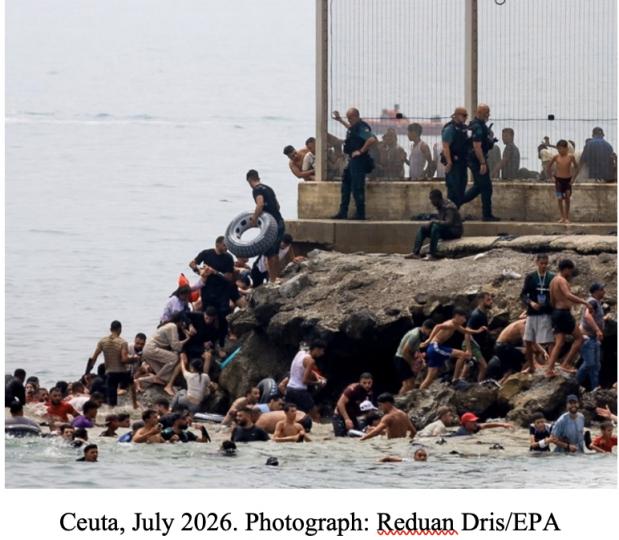
The implementation of the EU Pact on Migration and Asylum demonstrates this particularly well, while the events in Ceuta in July 2026 remind us how rapidly migration, border management, vulnerability, security and fundamental rights can become matters of life and death[10]. The Pact’s new monitoring architecture requires independent scrutiny of compliance with fundamental rights in border procedures. Yet independent monitoring is not merely a legal or human-rights exercise, but also a core field of criminological engagement and authority. It involves institutional and organised criminal behaviour, police discretion and misconduct, reporting and non-reporting, vulnerability, victimisation, criminalisation, trust, evidence, implementation and evaluation. However, systematic criminological expertise remains conspicuously underrepresented in the ongoing methodological discussions about the design of that monitoring[11].
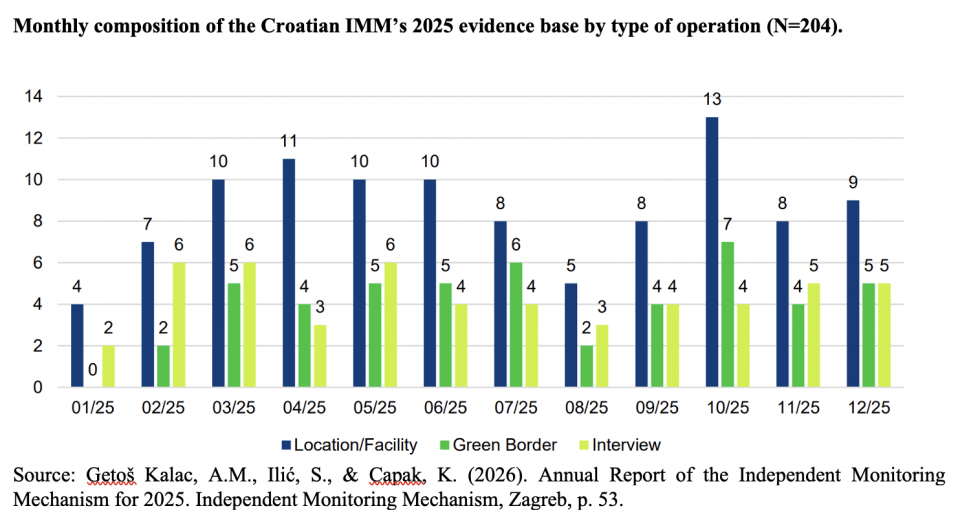
Five years of work with Croatia’s Independent Monitoring Mechanism - particularly designing and upgrading its methodological and operational architecture while engaging with domestic and European actors and the relevant publicly available ‘grey literature’ - have given me first-hand insight into how this field operates. Independent monitoring works best through critical but constructive engagement between independent experts, those whose practices are monitored and affected populations, supported by a robust methodology and evidentiary architecture that distinguishes observations from assumptions and findings from expectations. We developed risk-based sampling; conducted unannounced green-border and police-conduct monitoring operations and migrant interviews (see graph below); tested standardised tools; compiled evidence packages; initiated referrals of irregularities; and built follow-up, multilayer verification and public reporting into the system. Its transdisciplinary work brought Criminology and Victimology together with asylum, criminal and European Law, Medicine, Criminalistics, Security Studies, crisis management, Pedagogy, humanitarian and inter-cultural expertise.
One deceptively simple example of what hands-on criminological authority can contribute is the IMM’s “Letter of Rights and Complaints” Procedure[12]. It provides migrants with standardised information about their rights, creates a documented channel for complaints concerning police conduct and makes that channel itself subject to external monitoring. Following its successful pilot, the Croatian Ministry of Interior decided to implement it voluntarily and nationwide. It offers a concrete model for other jurisdictions as comparable mechanisms develop across the EU. What matters here is not the Letter itself, but the model of criminological engagement it reflects.
As criminologists, we work with practitioners and institutions while retaining independence: identifying vulnerabilities, understanding operational realities, translating knowledge into workable safeguards, scrutinising implementation and evaluating whether an intervention works. In doing so, we show that engaged Criminology need not become advocacy, and that criminological authority does not require distance from practice or indifference to suffering, but independence of judgement. Our discipline should be particularly attuned to the dangers of replacing questions with conclusions and evidence with accusations, especially in morally and politically charged fields - as many, perhaps most, criminological topics are to some degree .
That insistence on individual responsibility, evidence and equal treatment seems particularly worth remembering as we meet in Warsaw for our conference. Few European cities offer a more immediate reminder of the catastrophic consequences of antisemitism and the denial of equal human worth. Before the Holocaust, Warsaw was one of the great centres of Jewish life in Europe. That history does not decide contemporary political disputes. It should, however, sharpen our criminological lens for examining whether, and under what circumstances, collective attribution or unequal treatment may acquire an antisemitic dimension. Neither criticism of the Israeli government nor advocacy of anti-Israeli boycotts as a form of political protest is, in itself, antisemitic. But singling out Israeli affiliation or identity - or scholarly opposition to academic boycotts - for exceptional treatment, construing any of these as evidence of personal criminal conduct or complicity, or using them as a basis for exclusion or public stigmatisation has no place in any scholarly community, least of all a criminological one. For a scholarly society, and particularly for us as criminologists, consistency in equal treatment and in the criteria we apply is not merely a matter of fairness or methodological rigour. It is an essential condition of credibility.
This brings me, finally, to the responsibility that comes with governing our Society. The Presidency - and indeed every position of responsibility within the ESC - is an honour, a recognition and a privilege, as much as it is an obligation and a duty of stewardship. Election or appointment to office does not transform personal convictions, however sincerely or strongly held, into positions of the Society. Nor does the authority attached to office belong to any of us personally. It is entrusted temporarily for the purpose of fulfilling our Society’s mission. The greater the authority of the office - and the stronger one’s prior public commitment to a contested matter, or where a potential conflict of interest exists - the greater the obligation to distinguish personal conviction from institutional mandate and to manage conflicting interests in favour of the Society’s constitutional mission.
We strengthen the ESC because it is our “criminological home (away from home)”: a space in which we can flourish, challenge one another, educate future generations and share research and knowledge. That is how I understand loyalty to the ESC and my membership, as well as the trust placed in me as President. This trust I likewise place in the future of our Society - a future grounded in institutional integrity, intellectual courage, common scholarly standards, the capacity to compromise in challenging times, and a genuine embrace of diversity of colleagues, knowledge and perspectives. Such a future depends not on everyone singing in a choir conducted by a privileged, deserving or vocal few, but on our willingness to remain open, rigorous, pluralistic and welcoming enough for genuine, reasoned disagreement - and on turning that diversity into contributions that matter within and beyond our community. Such diversity is not only constitutionally protected and academically valuable. It is what allows Criminology to question itself, advance knowledge and contribute beyond its disciplinary boundaries. That is how a scholarly society should function, and the condition under which any of us - and the Society itself - may claim to speak with criminological authority.
References:
Farber, S. (2024). The hidden boycott: experiences of Israeli academics during the Israel-Hamas war. Israel Affairs 30(5), pp. 1006–1024.
Getoš, A.M. (2012). Politische Gewalt auf dem Balkan: Schwerpunkt Terrorismus und Hasskriminalität: Konzepte, Entwicklungen und Analysen. Berlin: Duncker & Humblot
Getoš Kalac, A.M. (2023). (Cyber) Bullying by Faceless Bureaucracy in Research Funding: A Case Study from the Balkans. In: Havrekamp, R. et al. (Eds.) Unterwegs in Kriminologie und Strafrecht – Exploring the World of Crime and Criminology. Berlin: Duncker & Humblot, pp. 511-540.
Getoš Kalac, A.M., Ilić, S., & Capak, K. (2026). Annual Report of the Independent Monitoring Mechanism for 2025. Independent Monitoring Mechanism, Zagreb, available online: https://www.nmn.hr/reports/20, accessed August 10, 2026.
Kranz, D. & Liebig, S. (2026). A Silent Boycott is Like Gaslighting - Makes You Doubt Yourself. Soziologie 55(3), pp. 318-326.
Muraille, E. (2026). Are Committees on Respect for International Law within universities a new threat to academic freedom? Frontiers in Education, 10, pp. 1-22.
Vrielink, J., Lemmens, P. & Parmentier, S. (2011). Academic Freedom as a Fundamental Right. Procedia Social and Behavioral Sciences, 13, pp. 117–141.
[1] Getoš Kalac, A.M. (2024). Election of ESC President: Candidate Profile Anna-Maria Getoš Kalac. Newsletter of the European Society of Criminology 22(2): https://escnewsletter.org/storage/summaries/adfbae04-5afc-40ae-b0e9-b5ba1282c999.pdf
[2] On “science activism” and “political activism” see: Getoš Kalac, A.M. (2026). Logos of Criminology: Harm, Conflict, and Academic Freedom. Newsletter of the European Society of Criminology, 23(3), available here: https://escnewsletter.org/storage/summaries/3625c8d8-47c7-47bb-939b-35dd34265c58.pdf
[3] See Getoš Kalac (2023) and Getoš Kalac, Ilić & Capak (2026).
[4] See Getoš, A.M. (2012).
[5] ESC Member Consultation on 2025 General Assembly Matters, available online: https://esc-eurocrim.org/v2/esc-member-consultation-on-2025-general-assembly-matters/.
[6] Guidelines for participants in ESC activities, available online: https://esc-eurocrim.org/v2/guidelines-for-participants-in-esc-activities/.
[7] Statements of the Executive Board of the ESC, adopted on 31 August 2025, August 2025, and 8 November 2024, available online: https://esc-eurocrim.org/v2/news/.
[8] For empirical research see for example Kranz & Liebig (2026), and Farber (2024). For a detailed analysis of the implications of academic boycotts and university responses, see for example Muraille (2026).
[9] See Vrielink, Lemmens & Parmentier (2011).
[10] Jones, S. (30 July 2026). Spain sends extra troops and police to Ceuta after thousands of migrants arrive: Unknown number of people have swum and waded into Spanish enclave that neighbours Morocco. The Guardian, available online: https://www.theguardian.com/world/2026/jul/30/thousands-enter-spanish-enclave-ceuta-morocco-africa, accessed August 10, 2026.
[11] See for example: European Commission (8 May 2026). Report on the state of play on the implementation of the Pact on Migration and Asylum, available online: https://home-affairs.ec.europa.eu/report-state-play-implementation-pact-migration-and-asylum_en, accessed August 10, 2026; Fundamental Rights Agency (21 July 2026). Migration and Fundamental Rights Bulletin - 2/2026, available online: https://fra.europa.eu/en/publication/2026/migration-bulletin-2-2026, accessed August 10, 2026.
[12] See Getoš Kalac, Ilić & Capak (2026), pp. 74-75 and 128-129.