Annual Secretariat report

Marcelo Aebi
Executive Secretary of the ESC
09-04-2026
In brief
The 25th Annual Meeting of the European Society of Criminology (ESC), held in Athens, Greece, in September 2025, coincided with the twenty-fifth annual ESC conference and marked a year of renewed growth for the Society. Key highlights include:
- Membership rebound: ESC membership rose to 2,103 members, a 35% increase over the 1,560 members of 2024 and the second-highest total in the Society's history, just short of the 2023 record of 2,175.
- Sustained global representation: Members from 64 countries - 66 if figures for the United Kingdom are broken down by nations - across the five inhabited continents, with European countries accounting for 78% of membership.
- Student engagement: Student members reached 569, the highest absolute number in the Society's history, representing 27% of total membership.
- Anniversary conference: Eurocrim 2025 in Athens, held under the title “Logos of Crime and Punishment”, attracted 2,230 participants, making it the second-largest conference ever organised by the ESC.
- Awards: Six awards were presented, including the ESC European Criminology Award to Ernesto Savona for his lifetime contribution to European criminology and the Distinguished Services to the ESC Award to Krzysztof Krajewski.
- Summer School: The second ESC Summer School took place in Lausanne in June 2025, continuing the initiative launched in 2024 for the education of emerging scholars.
- Oral history: The European Criminology Oral History Project (ECOH) conducted two new interviews during the Athens conference, while the interviews recorded in Bucharest in 2024 were published on the ESC YouTube channel.
- Leadership transition: Letizia Paoli was elected President-Elect of the ESC, and Mirza Buljubašić as an At-large ESC Executive Board member.
- Member consultation: The General Assembly in Athens gathered some 700 members and hosted a debate on the Society’s position regarding international conflicts; in follow-up, the Executive Board conducted a membership-wide consultation (January - February 2026), on the basis of which it issued, in March 2026, a statement on the war in Gaza and the Israel/Palestine conflict and adopted rules for specifying institutional affiliations in accordance with International Law in Eurocrim publications.
Trend in ESC membership from 2001 to 2025
The year 2025 saw a rebound in the membership of the European Society of Criminology (ESC), which rose to 2,103 members, an increase of 34.8% over the 1,560 members registered in 2024. This figure represents the second-highest membership total in the history of the Society, after the 2,175 members reached in 2023 (figure 1).
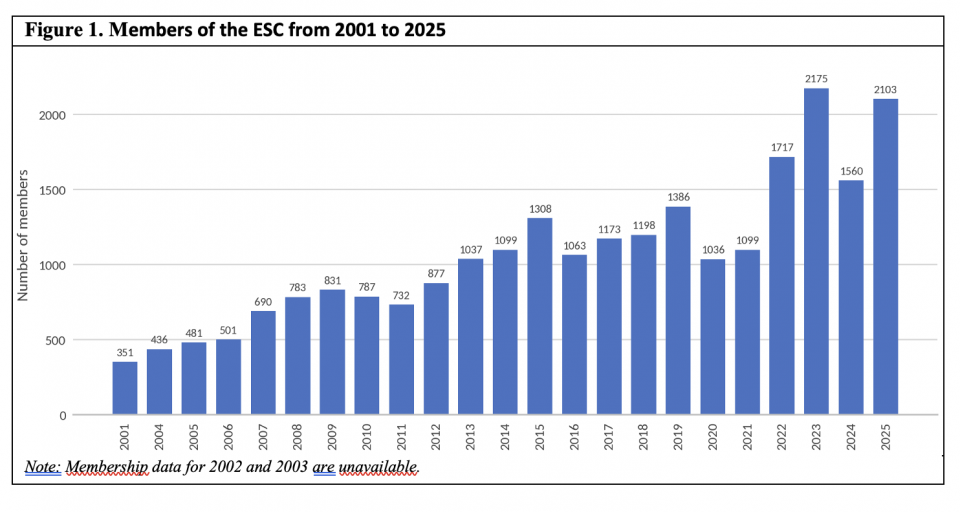
This rebound confirms the cyclical pattern described in previous reports, according to which conference location and timing significantly influence membership numbers. The appeal of Athens as a conference venue, combined with the anniversary character of the 25th annual ESC conference, favoured membership growth, as the Florence conference had done in 2023. Beyond these fluctuations, the underlying trend is clear: 2025 was the fourth consecutive year with more than 1,500 members, and the 2025 total is roughly 50% higher than the pre-pandemic maximum of 1,386 members recorded in 2019.
A notable development in 2025 was the growth of student membership, which reached 569 members - the highest absolute number ever recorded by the Society - representing 27.1% of total membership, compared to 25.6% in 2024 and 24% in 2023. This increase in student representation likely reflects the engagement of the emerging generation of criminologists and the role of initiatives such as the ESC Summer School.
The link between conference attendance and membership remains evident.
Geographical distribution of ESC members in 2025
The year 2025 saw an increase in the geographical diversity of ESC members, with representation from 64 countries - 66 if figures for the United Kingdom are broken down by nations - across the five inhabited continents. The growth in total membership was accompanied by an increase in the share of members from outside Europe (figure 2).
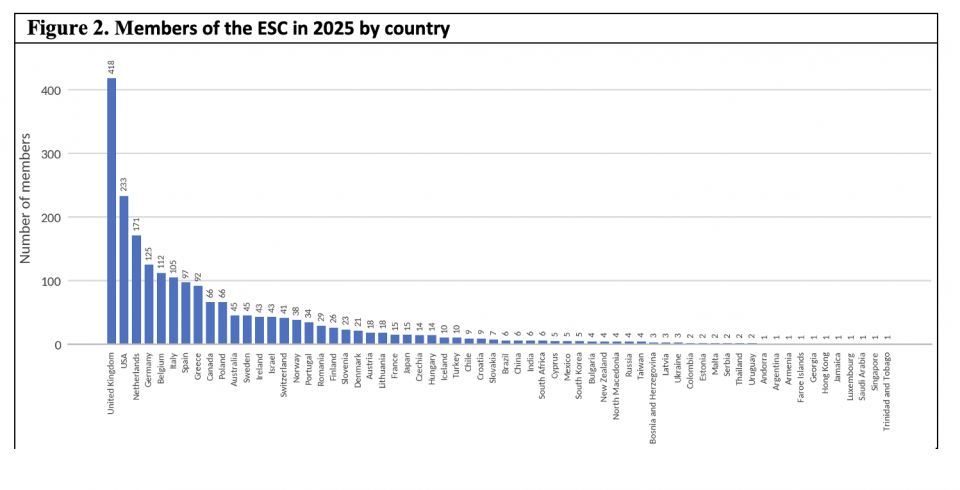
European countries continued to form the core of the Society, accounting for approximately 78% of the total membership (1,638 members). At the same time, the proportion of members from non-European countries rose to 22% (465 members), compared to 16% in 2024. This increase was driven in particular by North American and Australian participation in the Athens conference.
The United Kingdom maintained its position as the country with the highest number of members, contributing 418 individuals or 20% of the total membership. The United States of America moved into second place with 233 members (11.1%), overtaking the Netherlands, which counted 171 members (8.1%). These figures reflect the continued participation of the North American criminological community in the Society.
Germany (125 members), Belgium (112), Italy (105), and Spain (97) remained among the most represented continental European countries. Greece, the host country of Eurocrim 2025, illustrates the conference-location effect: its membership rose to 92 members (4.4%), compared to 23 in 2024.
The Nordic countries maintained their presence within the ESC, with Sweden leading at 45 members, followed by Norway (38), Finland (26), Denmark (21), and Iceland (10), together representing approximately 6.7% of total membership.
Central and Eastern European countries also grew, led by Poland with 66 members - a figure likely boosted by the upcoming Warsaw 2026 conferencefollowed by Romania (29), Slovenia (23), Lithuania (18), Hungary (14), Czechia (14), Croatia (9), and Slovakia (7). This reflects the continued integration of criminological communities in the region, to which the Society has been committed since the Kraków conference of 2005.
Beyond Europe and North America, members also came from Australia (45), Israel (43), Japan (15), India (6), China (6), and South Korea (5), as well as from Latin American countries such as Chile (9), Brazil (6), Mexico (5), Colombia (2), Uruguay (2), and Argentina (1), and from South Africa (6).
In sum, the geographical distribution of ESC members in 2025 reflected a diverse international community, with growth in both the total membership and its non-European component.
Eurocrim 2025 in Athens: The 25th Annual Meeting of the ESC
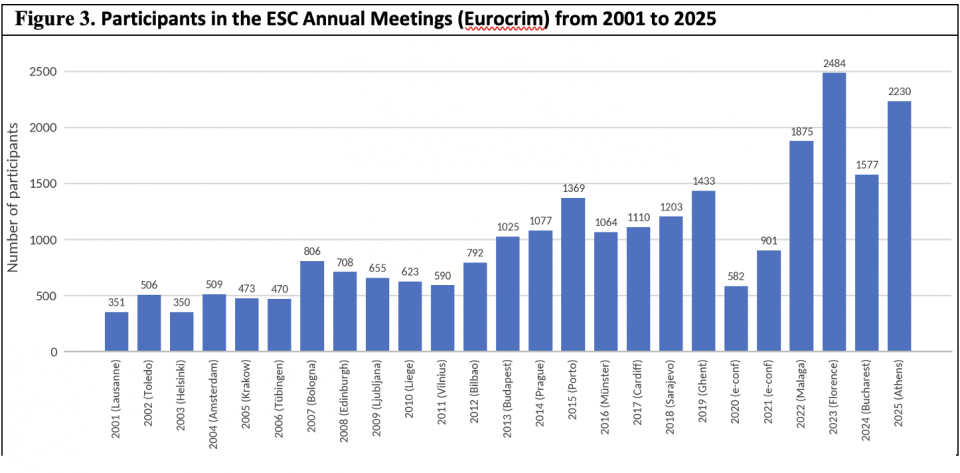
Under the title “Logos of Crime and Punishment”, the 25th Annual Meeting of the ESC, Eurocrim 2025, was held in Athens, Greece, from 3 to 6 September 2025. The conference attracted 2,230 participants from some 68 countries, making it the second-largest conference in the history of the Society, after the 2,484 attendees of Florence 2023 (figure 3).
The Athens conference marked a quarter of a century of annual ESC meetings since the founding conference held in Lausanne in 2001, which gathered 351 participants. The choice of Athens - long associated with democracy and logos - provided a fitting setting for this anniversary, and the conference’s opening ceremony offered an opportunity to look back on the Society’s development since its foundation. The addresses delivered at the ceremony were published in the preceding issue of this Newsletter.
The General Assembly, held on 5 September 2025, was attended by some 700 members, the largest attendance in the history of the Society. Besides the customary statutory items, the Assembly devoted a substantial part of its session to a discussion of the Society’s stance towards international conflicts within and beyond Europe, particularly in relation to the war in Gaza and the broader Israel/Palestine conflict. At the close of the discussion, the Executive Board committed itself to returning to the membership with a set of concrete questions to be submitted to a membership-wide consultation. The membership-wide consultation that followed is presented in the next section.
The relationship between conference attendance and membership remains evident, with both metrics rebounding in parallel from their 2024 levels and approaching the historical peaks of 2023. The next conferences are already scheduled: Warsaw, Poland, will host Eurocrim 2026 (9 to 12 September), followed by Skopje, North Macedonia, in 2027, and Dublin, Ireland, in 2028.
The member consultation on 2025 General Assembly matters
The discussion held at the Athens General Assembly originated in a motion submitted by a group of members, which requested a vote on the Society’s position regarding the war in Gaza. On the basis of the legal guidance it had sought, the Executive Board considered that parts of the motion were incompatible with the ESC Constitution - in particular, exclusionary measures such as denying membership or conference participation on the basis of a person’s nationality or their link to a particular state, territory, or institution - and that such measures would also be legally risky under Swiss law. The motion was therefore not put to a vote at the Assembly, but time was allocated for its presentation and for an open discussion in which members holding diverse views took the floor.
The Executive Board views this debate as a manifestation of a broader discussion about the role of the social sciences: a considerable portion of the membership believes that imposing a particular normative or moral perspective on scholarly activity is inherently unscientific, while another substantial contingent is uncomfortable with a Criminology that does not publicly denounce injustices, with many members holding intermediate positions. The role of the Board, in that context, was not to serve as final arbiter in these debates, but to guide the Society through current events in a manner that allows members across this range of views to continue feeling at home within the ESC.
In fulfilment of the commitment made in Athens, the Executive Board adopted, on 29 January 2026, the ESC Voting Document: Questions, Context and Actionable Plans (2025 General Assembly Matters), available on the ESC website. This document distilled the central issues raised by the members into a set of concrete, legally compliant questions, each accompanied by its context, by draft guidelines, and by an actionable plan describing the steps that would follow each voting outcome. The vote was conducted as a membership-wide consultation initiated by the Executive Board - not as a formal referendum in the sense of Section 6(6) of the ESC Constitution - but the Board committed itself to treating the outcome as binding upon itself and to implementing it in good faith through the relevant policies, procedures, and practical arrangements.
The consultation was open from 30 January to 10 February 2026 and was conducted through a secure online voting platform guaranteeing the anonymity of the responses. It was open to the 2,103 members of the 2025 cohort - who had raised and debated these issues online and at the Athens General Assembly - as well as to the members already registered for 2026 by 29 January 2026. In total, 2,159 members received a personal voting link, 620 opened it, and 523 submitted a completed ballot, corresponding to 24.2% of those invited to vote. In line with the procedure announced in advance, the results were calculated on the basis of the Yes/No votes, with abstentions recorded separately.
The results were communicated to the membership on 12 February 2026 and published on the ESC website. On question 1a, concerning the issuing of public statements about international conflicts characterised by mass atrocities and serious human rights abuses within Europe, 357 members voted yes and 150 voted no, with 16 abstentions; the yes option thus obtained 70.4% of the Yes/No votes, corresponding to 68.3% of the 523 completed ballots. On question 1b, concerning statements about such conflicts outside Europe, 308 members voted yes and 196 voted no, with 19 abstentions; the yes option obtained 61.1% of the Yes/No votes (58.9% of the completed ballots). On question 1c, concerning a public statement about the war in Gaza and the broader Israel/Palestine conflict, 316 members voted yes and 188 voted no, with 19 abstentions; the yes option obtained 62.7% of the Yes/No votes (60.4% of the completed ballots). Finally, on question 2, concerning the addition - alongside the self-designated institutional affiliations, and in Eurocrim publications only - of the geographical location of institutions as specified under International Law, 298 members voted yes and 184 voted no, with 41 abstentions; the yes option obtained 61.8% of the Yes/No votes (57.0% of the completed ballots).
In implementation of the outcome of the consultation, the Executive Board adopted, on 6 March 2026, the Statement on the War in Gaza and the Israel/Palestine Conflict, available in the news section of the ESC website and drafted in accordance with the guidelines annexed to the Voting Document. Under those guidelines, any future statement on an international conflict - within or outside Europe - remains reserved for exceptional cases directly related to the Society’s core concern, the study of crime and societal reactions to crime, and subject to the strict conditions they set out. In addition, as from the Warsaw 2026 conference, the geographical location of institutions located in disputed or occupied territories will be specified in Eurocrim publications, alongside the self-designated affiliations, on the basis of authoritative sources of International Law and without any effect on conference participation.
ESC Awards
In 2025, the ESC presented six awards: the ESC European Criminology Award, the ESC Young Criminologist Award, the European Journal of Criminology (EJC) Best Article of the Year 2024 Award, the ESC Early Career Award, the ESC Book Award, and the Distinguished Services to the ESC Award. The awardees received their plaques and diplomas during the opening ceremony of the 2025 Eurocrim conference in Athens, Greece.
2025 European Criminology Award
The 2025 ESC European Criminology Award, recognising a lifetime contribution to European Criminology, was presented to Ernesto Savona. The award committee, composed of former ESC presidents Catrien Bijleveld (chair, NSCR and Vrije Universiteit Amsterdam, Netherlands), Klaus Boers (University of Münster, Germany), and Josep Maria Tamarit (Universitat Oberta de Catalunya, Spain), highlighted Professor Savona's academic career of almost 55 years. As one of the founders of the ESC, he has authored some 150 publications and founded Transcrime, a research institute that he built and developed into an international reference for research on organised crime. The committee noted his empirical research - including the development of crime risk assessment mechanisms and methods for assessing the vulnerability of legal sectors - the large number of scholars trained at Transcrime, and his frequent consulting work for supranational and international organisations such as the European Union and the United Nations, and concluded that he is a scholar of global eminence and impact.
2025 ESC Young Criminologist Award
Nikki Rutter received the 2025 ESC Young Criminologist Award for her article “Explosive and Harmful Impulses: A Subset of Child and Adolescent-to-Parent Violence and Abuse”, published in 2024 in the Journal of Interpersonal Violence. The award committee, composed of Josep M. Tamarit-Sumalla (chair, Universitat Oberta de Catalunya, Spain), Anna Di Ronco (University of Bologna, Italy), and Marieke Kluin (Leiden University, the Netherlands), praised Dr. Rutter's work for challenging entrenched assumptions about family violence by illuminating a particularly overlooked form of harm - impulsive and emotionally driven violence by children and adolescents towards their caregivers. The committee highlighted her refusal to reduce complex behaviours to simple explanations, positioning this form of violence within broader contexts - neurodivergence, trauma, and structural marginalisation - and her innovative conceptual distinction between intentional and non-intentional forms of child and adolescent-to-parent violence.
EJC Best Article of the Year 2024 Award
Enes Al Weswasi was honoured with the European Journal of Criminology Best Article of the Year 2024 Award for his paper “Estimating the incapacitation effect among first-time incarcerated offenders”, published in issue 21/6 of the European Journal of Criminology. The award committee, comprising ESC President Michele Burman (University of Glasgow, Scotland, United Kingdom), 2023 EJC Best Article of the Year Award winner Florian Kaiser (Max Planck Institute for the Study of Crime, Security and Law, Freiburg, Germany), and EJC Editor-in-Chief Kyle Treiber (University of Cambridge, England, United Kingdom), described the study as cleverly designed, applying a meticulous state-of-the-art propensity score matching approach to detailed Swedish data. The paper shows that incapacitation has modest effects overall, while being much stronger for those at the highest risk of incarceration, providing evidence that non-custodial sanctions may be a favourable alternative especially for those at low risk. The jury agreed that the paper makes an important and robust empirical contribution to a seminal criminological question with direct implications for criminal justice policy.
2025 ESC Early Career Award
The 2025 ESC Early Career Award, recognising outstanding scientific achievement by an early career European criminologist, was presented to Miguel Basto Pereira. The award committee, consisting of Anna-Maria Getoš Kalac (chair, University of Zagreb, Croatia), Anna Di Ronco (University of Bologna, Italy), and Ineke Haen-Marshall (Northeastern University, Boston, United States of America), commended Dr. Basto Pereira's significant contributions to developmental and life-course Criminology, which have advanced our understanding of the risk factors underlying the development and persistence of criminal careers. The committee underlined that his contribution has been both methodological and conceptual, through the development of innovative methodologies and of a new conceptual framework for the analysis of key childhood vulnerabilities that expose individuals to risks of antisocial behaviour and crime along the life-course, and noted his impressive track record for an early career scholar.
2025 ESC Book Award
Silvia Gomes and Dixie Rocker received the 2025 ESC Book Award for their work “Gender, Prison and Reentry Experiences: A Matter of Time”, published by Routledge in 2024. The award committee, composed of Anna-Maria Getoš Kalac (chair, University of Zagreb, Croatia), Marieke Kluin (Leiden University, the Netherlands), and Evelyn Svingen (University of Birmingham, England, United Kingdom, winner of the 2024 award), reached a unanimous decision. The committee described the book as a thoughtful and timely contribution to Criminology, Sociology, and Gender Studies, which addresses a notable gap in the literature by focusing on the first phase of reentry - the period still spent within prison walls - thereby challenging the common assumption that reentry begins only after release. It also praised the integration of a substantial number of interviews conducted in various prison settings and the authors' careful analytical restraint.
2025 Distinguished Services to the ESC Award
The 2025 Distinguished Services to the ESC Award was presented to Krzysztof Krajewski in recognition of his outstanding service contributions to the effective functioning of the Society. The award committee was composed of ESC President Michele Burman (chair, University of Glasgow, Scotland, United Kingdom), Csaba Györy (Hungarian Academy of Sciences and ELTE Faculty of Law, Budapest, Hungary), and Marcelo F. Aebi (University of Lausanne, Switzerland). The committee stressed that Professor Krajewski has played a crucial role in the development and consolidation of the ESC from its early years, contributing with vision, commitment, and sustained service. His most visible contribution was the organisation of the 2005 ESC Annual Conference in Kraków, Poland - the first time the Society held its meeting in Central or Eastern Europe - whose success marked a turning point in the ESC's trajectory towards becoming a truly pan-European organisation.
All in all, these awards reflect the ESC's commitment to recognising and promoting excellence in criminological research and scholarship across Europe and beyond.
Briefs
Elections
In 2025, Letizia Paoli (KU Leuven, Belgium) was elected President-Elect of the ESC, and Mirza Buljubašić (University of Sarajevo, Bosnia and Herzegovina) was elected as an At-large ESC Executive Board member.
2025 ESC Summer School
The second edition of the ESC Summer School took place at the University of Lausanne from 9 to 13 June 2025, continuing the initiative launched in 2024 for the education of emerging scholars. Twenty young researchers from fourteen different countries were selected from forty applications, reflecting the demand for this educational opportunity within the criminological community.
The programme combined high-level scientific sessions with practical training on the design of competitive research proposals, including the Marie Skłodowska-Curie Actions and the ERC Starting Grants. In line with the spirit of the Summer School, most of the speakers - Per-Olof Wikström, Anna Sergi, Eric Beauregard, Florian Kaiser, and Gian Maria Campedelli - were recipients of ESC awards, and ESC President Michele Burman also took part as a speaker. The programme was completed by social and community-building activities, supported by the University of Lausanne.
European Criminology Oral History Project (ECOH)
Under the supervision of José A. Brandariz with the support of Ignacio González-Sánchez, the European Criminology Oral History Project (ECOH) continued its activities during Eurocrim 2025 in Athens, where two new interviews were recorded: Michele Burman interviewed by Lesley McAra, and Vania Ceccato interviewed by Gilda Santos. In addition, the six interviews recorded during the Bucharest conference in 2024 were published on the ESC YouTube channel in the course of 2025, contributing to preserving the history of European Criminology for future generations.
Keep in touch
To stay up to date with the latest ESC news, please visit:
- The ESC website
- The ESC Newsletter website
- X (formerly Twitter): @esc_eurocrim https://x.com/esc_eurocrim
- YouTube channel