Presidential address, by Anna Maria Getoš-Kalac
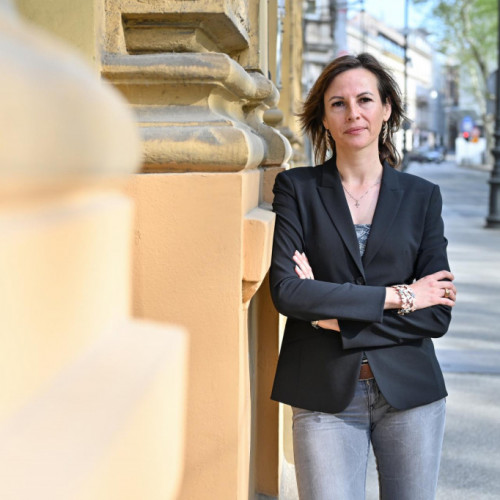
Anna-Maria Getoš-Kalac
University of Zagreb
01-28-2026
Logos of Criminology: Harm, Conflict, and Academic Freedom
Dear colleagues,
Thank you for the trust you have placed in me by electing me President of our Society. I would also like to thank Josep M. Tamarit-Sumalla and Ineke Haen-Marshall, who have completed their mandate on the Executive Board, and to welcome Letizia Paoli (President-Elect), Mirza Buljubašić (at-large Board member) and Angelina Stanojoska, who will organise our Annual Conference in Skopje in 2027.
I am, as I believe we all are, particularly grateful to Effi Lambropoulou and her entire team for organising our Society’s 25th anniversary Annual Conference in Athens that took place under the inspiring theme ‘Logos of Crime and Punishment’ – ‘logos’ in classical Greek thought referring to a universal (divine) reason immanent in nature, yet transcending all oppositions and imperfections in the cosmos and humanity[1]. In the final days leading up to the conference, and throughout the event itself, the entire organising team demonstrated not only tremendous resilience, but also a truly Athenian spirit: a spirit with strong symbolic appeal for us as a Society to remain a community of reason, pluralism and civic virtue, even amid sharp disagreements.
I took office at a moment that is unprecedented in the history of our Society, as documented in the first half of the conference report by Wim Huisman. The political controversy ahead of and surrounding our conference, as well as the months that followed, confronted us as a Society with intense pressure, escalating conflict, and widespread distress that many of us may not have previously encountered within a scholarly association.
It is tempting to treat all these events primarily as a political controversy, and from that perspective to (mis)use a presidential message to promote one set of views over another, backed by our Society’s authority. I will, however, make an honest effort to do something else: to reflect on it through our shared disciplinary lens – which makes us, as a Society, stand together, and as criminologists stand with and for, not against, each other. In doing so, I want to make a reasonedcontribution to reaffirming common ground for mediation, since the logos of Criminology – our obligation to reasonabout harm, conflict and our responses to them – also obliges us, professionally, in how we act within our Society.
The European Society of Criminology, for most of us, is far more than a scientific annual conference. It is a scholarly community that offers both exchange of knowledge and a sense of belonging across borders, academic cultures, related disciplines and institutional contexts. For many of us, it has also been a formative “criminological home (away from home)”[2]: a welcoming, safe space of international academic socialisation, learning, mentoring, growth, and flourishing, including spirited debate. Recently, however, our “home (away from home)” has also been experienced as a volatile space – one in which some feel disrupted or silenced, others feel targeted or excluded, and still others feel compelled to defend themselves against accusations unrelated to common scholarly discourse. Our experiences differ, as do our perspectives. Yet the fact that so many among us report distress, fear, and lasting hurt should concern us all, and particularly as a Society.
As criminologists, we have the tools to engage with these dynamics scientifically: not to pathologise each other or our Society, nor to reduce complex moral positions to “mere behaviour,” but to understand how conflict escalates in institutions, how harm is produced and distributed, and how bystanders and organisational structures shape outcomes. In the limited format of a newsletter message, I cannot offer a comprehensive analysis. Instead, I will focus on one particular aspect: the harmful experiences reported by those among us who have been treated as if their vulnerability were less visible, less credible, or less deserving of our attention.
A starting point should be simple and honest: harm has been experienced broadly and across positions within and by our Society. Some accounts have already been documented and discussed – most notably through communications on our Society’s webpage and on the webpage of Criminologists for Palestine, at our General Assembly, and in (open) letters to the Board [3]. The purpose here is not to adjudicate competing narratives, or to rank suffering, nor to assign blame. It is to acknowledge harmful experiences: feeling upset, distressed, coerced, oppressed, or professionally endangered – experiences that have no rightful place in any professional community, least of all in a criminological society.
One set of harmful experiences has, however, thus far received comparatively little if any attention: that of those among us being most directly affected by the ongoing controversy within our Society. Due to their institutional affiliations or nationality, they may not fit our Society’s current interpretation of Christie’s “ideal victim” – although they most certainly do when analysed dispassionately – and might therefore be perceived as less deserving of our acknowledgement and solidarity. The relevant Report [4] documenting our colleagues’ harmful experiences of being targeted, accused, disrupted, harassed and excluded is therefore, in my view, a must-read for us as a Society. Not only to figure out how to re-establish the safe space our Society has been widely known for, but also to factor in the unintended, though predictable, harmful by-products of dealing with the current, or any other, political controversy as a scholarly Society.
At a moment many of us contemplate how (and whether) to engage scientifically and/or politically with mass suffering across the globe, it matters that we also acknowledge and address the suffering within our own Society. One does not exclude the other. But promoting a culture of empathy and moral urgency outward, while ignoring vulnerability and experienced harm inward could further deepen divisions internally and thus seriously undermine our Society’s credibility externally.
This is not a call to deny, minimise, or relativise the mass suffering that has mobilised a strong sense of moral urgency in our Society. A criminological approach begins by recognising suffering and vulnerability. And it also asks further questions: what forms of collective behaviour and institutional reaction reduce harm, and what forms reproduce or amplify it – especially in the face of fear, blame, and moral certainty? As we move forward, it might be helpful to focus less on each other’s asserted motives or goals and more on the observable effects of the strategies and tactics we use—on colleagues, on governance, and on our Society’s capacity to function as a scholarly community.
In that regard we might perhaps want to distinguish more consciously between science activism and political activism, without praising, nor dismissing either. Some of us engage in neither; others in one or the other; and some in both, whereby neither engagement is a duty, least of all something to be imposed on anyone. It is a matter of professional and personal choice, and has been a subject of long-standing debate within Criminology and in science generally. What matters here is that both strategies of engagement operate through different methods and tactics, and therefore place different demands on institutional settings.
Science activism, in our context, can be understood as evidence-based engagement: criminologists bringing research, data, and transparent reasoning into public debate and policy processes. It is compatible with pluralism because it invites critique, replication, and argumentation. It can be passionate and morally compelling, but without abandoning scientific standards. It strengthens academic freedom as it relies on scientific methods, scrutiny, and the right to dissent, whereby it need not rely on numbers – the key is the strength of the argument. A simple heuristic is the “peer review test”: whether the central claims, as presented, withstand scientific scrutiny as a contribution to Criminology.
Political activism on the other hand aims at mobilisation, pressure, symbolic alignment, and institutional positioning, including boycotting, as a recognised form of political (not scientific) protest. It may use moral language designed to compel agreement rather than invite inquiry, whereas it does not depend on scientific scrutiny. The challenge, in our Society’s context, arises when political activism is channelled through a scholarly association and its scientific authority in ways that demand the association itself adopt political positions, enforce political categories, or apply implicit loyalty tests. At that point, scholarly associations risk becoming instruments of political alignment rather than free scientific spaces of scholarly exchange.
Even in academic contexts, pressure tactics can emerge – sometimes intentionally, sometimes as a by-product of escalations. These might include reputational threats, public shaming, sweeping moral accusations (e.g., complicity), disruption, and intimidation-by-mobilisation. Whatever one thinks about the underlying cause, such tactics have predictable effects: they raise the personal cost of participation, they create fear-induced silence, they further isolate those who are already vulnerable, and they make ordinary governance feel too risky to sustain. Criminology has long studied how coercion can operate without formal force – through stigma, reputational damage, threatened (in)direct exclusion, and the production of fear. When such tactics appear in scholarly communities, it is not “political” to name them; it is part of our discipline to ask who is harmed, who self-censors, who becomes “safe to attack,” what patterns of victimisation emerge, and how are we supposed to deal with it.
This brings us to the basic rules we as a scholarly Society agreed to. We are not an informal collective, but a constitutional association with a statutory framework, defined membership rights and duties, and responsibilities under Swiss law. Governance is not mere bureaucracy. It is what protects inclusivity, diversity, pluralism, and lawful decision-making – especially under pressure. When constitutional rules are treated as obstacles to urgency, as a Society we become vulnerable to fragmentation, discrimination, and legal exposure. In the months ahead, the question is not simply what we as members want, but first and foremost what the Society may lawfully do, and by which statutory procedures. These constraints are neither optional nor accidental: they protect us as a scholarly Society – sometimes even from ourselves.
None of this should be a matter of political taste or personal opinion. If we take seriously the idea of being criminological scholars, then this commits us to one core value: academic freedom. Not only when it is convenient or aligns with our goals, but especially when it protects those among us who are vulnerable, unpopular, or exposed—and when it protects us as a Society from harmful dynamics that make us turn against each other.
If there is one point on which I am almost certain we can all agree, it is this: none of us should feel excluded, intimidated, criminalised, harassed, or professionally threatened within, or in relation to, our Society – regardless of scholarly or personal opinion, nationality, or institutional affiliation. From this shared acknowledgement of harm, we can begin to process its impacts, rebuild mutual trust, and recommit – together – to academic freedom as our common value. That means, at least to me, not only preserving our “criminological home (away from home)”, but also standing in solidarity with all colleagues in our Society, particularly those who have been singled out, shamed, or silenced because of the politics of their governments or institutions, or their scholarly or personal opinions.
[2] Election of ESC President: Candidate Profile Anna-Maria Getoš Kalac, Newsletter of the European Society of Criminology, 2024, 22/02.
[3] For more details, see the Conference Report in this issue of the ESC Newsletter.
[4] Report on Academic Freedom and the Boycott Campaign within the ESC (2025) by Beatrice Coscas Williams